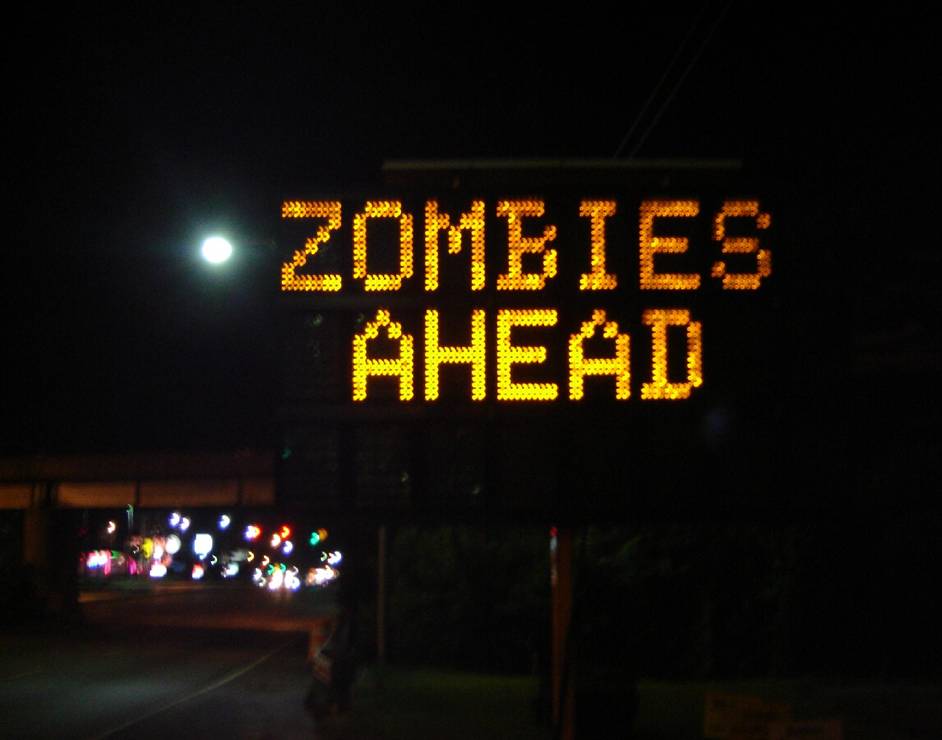
Skeptics love to debunk zombies and the undead. The idea of a zombie outbreak presents several logical points open for debate, such as causes, physiology, the contagious nature of an epidemic and even if a reanimated corpse is possible. Skeptics illustrate that conventional, “real” zombies exist only as a product of voodoo sorcery using tetrodotoxin, or TTX, as a means to incapacitate and render almost unconscious their victims.
For the sake of this argument, I will be referring to a zombie as not a member of the undead, but rather human bodies acting seemingly without a will of their own, with an intention to consume, destroy, or otherwise cause general grief to the remaining human populace.
Zombies in popular culture form three distinct classes:
- Walking Dead – undead, walking dead or reanimated corpses
- Viral – viral, parasitic or infected humans
- Scientific – scientifically altered humans, through radiation, poisons or drugs, or psychic conditioning
The Walking Dead
Our current understanding of human physiology, biology and chemistry tell us that a human corpse cannot rise, reactivate or in any other way reanimate. There must exist an external stimulus to bring about reanimation. If such a stimulus succeeds in reanimating a corpse though electricity, nutrient rich serum, or some strange radioactive measure, the corpse will still have difficulty with life support. A reanimated brain can function and provide basic skills such as breathing, blood pumping and simple motor skills, operating on a primitive, feral level. The reanimated head and brain show signs of smell, taste hearing and sight. This is evidenced by previous Soviet and current American experiments. An undead person would have one thought: feed to keep the body moving. The only problem is, the entire body would also be reanimated and would need energy to survive, much like any other human does. Air, water, food. Assuming a physiology like that of the living, a heart shot would be just as effective in destroying the undead. Muscles need air and energy, and this is pumped by the blood.
Read More »
Filed under: Brains · Reanimation · Science · Sickness · Solanum · Undead
In any conflict, one thing is key: your weapon. An uprising of the walking plague, legions of the undead, or hordes of zombies is no different. The well prepared and well armed survivor will have serveral weapons at his or her disposal: a trusty sidearm, a sturdy and damaging melee weapon, and a primary offensive weapon.
The most common primary weapon will probably be rifles, as machine guns and sub-machine guns are currently hard to come by for the general public. After the fall of military and policing units, they may be easier to acquire. Also common and equally as important, if not more destructive, is the shotgun. Current civilian shotguns are ususally limited to 2 or 5 rounds, or in the case of police issue Benellis a chamber of 8. This can be quite limiting when faced with large quantities of the undead. You need the rapid reload, fire and ammunition capacity of a sub-machine gun while harnessing the destructive power of the 12-gauge shotgun. The answer lies in a devestating new weapon being developed: the AA-12 Automatic Assault 12-gauge shotgun.
The reliability and usability of shotguns during a zombie outbreak is a hotly contested issue. On one hand, their ruggedness and stopping power are not to be underestimated. On the other hand, they take considerable time to reload and their muzzle climb and recoil negatively affect accuracy and successful headshot capability. The AA-12 seeks to eradicate these problems.
Carrying a 10, 20 or 32 round clip, firing a devastating 300 rounds per minute and having almost no muzzle climb or recoil, the AA-12 is the ultimate weapon for a zombie invasion. The only potential setback is such a weapon is not legal for a civilian to own as it has no legal sporting purpose. Durable, relaiable, strong and machined to withstand various climates, weather, water and grime, the AA-12 will maintain itself as a steadfast and deadly weapon for repelling undead hordes. Videos after the jump.
Read More »
Filed under: Defense · Preparedness · Weapons
Scientists in Pittsburgh are fooling around with reanimation and reviving the dead. It starts small, reviving totally, clinically dead dogs. The dead canine blood is replaced with a hypothermic oxygenated saline solution. Three hours later, the dogs blood is reintroduced, and they are revived with en electric shock. Hopeful scientists at the Safar Center for Resuscitation Research declare the process can be used on humans within a year.
Pittsburgh. Reanimated Corpses. The Zombie Holocaust.
Except this time, its not a movie.
Naturally, there are great medical benefits of prolonging death. It grants doctors more time to operate and save patients, but there remains a great unpredictable factor of bodily decay and brain rot associated with reanimating patients, even in a closely controlled setting. Even some of the dogs have suffered permanent damage.
I’m sorry, this center for reanimation is in fucking Pittsburgh. PITTSBURGH. Consistently the site of Hollywood zombie outbreaks, attacks, apocalypses, sightings, feasts and record-setting zombie mall walks. Those poor inhabitants of Monroeville, PA can ususally be found stumbling about in various states of decay and death, either at the mall, in the parking lot, or shambling the eight miles from the Safar Center for Zombie Creation.
The experiment bears a frightening similarity to that of Communist Russian scientists in the 1930’s that experimented with reanimating and sustaining life in severed dogs heads, as well as attaching multiple heads to single bodies. Surely this kind of practice cannot publicly be performed today, yet dogs remain an abundant and useful test subject for reanimation and resuscitation practices. A controversial communist Russia film was released in 1943 to American scientists. The video shows Reds working on a reanimated severed dogs head hooked up to an Autojektor, one of the first artificial hearts used to maintain life.
Read More »
Filed under: Films · Images · Reanimation · Science · Undead
“I’ll give you the 2012 thing”, she said, “but a zombie apocalypse? Come on, you don’t really believe that do you?”
The 2012 thing – if you’re reading this article, chances are you’re already familiar with it. The 2012 thing refers to the conveniently predicted end-of-the-world or great change coming December 21st, 2012. Many apocalypse theories are vague and dark, leaving many details rough, ambiguous and open to interpretation. The 2012 eschaton comes from several cultures and gives us a very certain date to prepare not necessarily for the end of existence or the world, but “the end of the world as we know it” – TEOTWAWKI.
The date of 12/21/12 is derived from the end of a 5,125 year cycle for the Mesoamerican Long Count calendar, most notably used by the Maya civilization. The calendar completes its 13th cycle from its starting point. Correlating the Mayan date to our Gregorian calendar yields several different dates ranging from the 21st through the 23rd, but the 21st seems likely, as it coincides with the winter solstice, and though astrology has little to do with our daily affairs, astronomically the Earth is said to be aligned facing the center of the Milky Way behind the Sun on the 21st. This interesting termination of the calendar in our immediate lifetimes is what brings many to reckon the date will bring about great global change or cataclysm.
Read More »
Filed under: Books · Brains · Reanimation · Science · Sickness · Undead

Stem cell research is a double edged sword. On one hand, the potential benefits to science, humanity and health are immense, and on the other hand it can be plagued with ethical and moral dilemmas involving life, cells, tissue and some may say – playing God.
Scientists in Britain are developing a technique to cultivate live tissue from the stem cells in dead embryos. This tends to escape any moral dilemma as the cells are no longer dividing and are considered dead. Dead tissue, brought to life. Nothing wrong there! I don’t have to explain much to illustrate where this is going.
Read More »
Filed under: Reanimation · Science · Undead